
Let’s Talk about mushrooms…. shall we!
Growing up in an African home in Tanzania, I always saw mushrooms pop up after it rained—only for them to disappear the next day as if they were never there. Elders would warn us to stay away from them unless they were the ones picked and brought home. Even they didn’t know how these humble mushrooms appeared. The situation is not only in Tanzania, but many places in the world.
Our Irish heritage lacked a tradition of teaching children anything nice about mushrooms. In this peculiar climate of ignorance, rains fell and mushrooms magically sprang forth, wilted in the sun, rotted and vanished without a trace …. Paul Stamet
In this article, we uncover the mystery of mushrooms so you can better understand what they are, how they grow, and why they matter. Join us as we dive in.
Are Mushrooms Plants? Surprisingly, No.
Many people place mushrooms in the “vegetable” category, but mushrooms are not plants. In fact, they are more closely related to animals than to plants. For many years, scientists classified mushrooms as strange plants that did not need sunlight. Later, they discovered that mushrooms are neither plants nor animals—they belong to their own kingdom: the Fungal Kingdom. The biggest difference between plants and mushrooms is how they obtain food: Plants have chlorophyll that captures sunlight, allowing them to make their own food through photosynthesis. Mushrooms, on the other hand, feed on dead or decaying organic matter by releasing enzymes that break it down and then absorbing the nutrients.
By breaking down organic matter, mushrooms release nutrients like nitrogen, phosphorus, and potassium back into the soil, crucial for plant uptake. This transformation is a cornerstone of soil fertility, influencing plant growth and, consequently, the entire food web.
Definition So, What Exactly Is a Mushroom?
A mushroom is the fruiting body of a fungus. It can form above the ground (what we see) or below the ground. The main role of a mushroom is to produce spores, which are like seeds, helping the fungus reproduce. You often see mushrooms during rainy seasons because moisture creates the right environment for fungi to produce mushrooms and spread their spores. For most of its life, the fungus actually lives hidden in the soil or inside decaying wood.
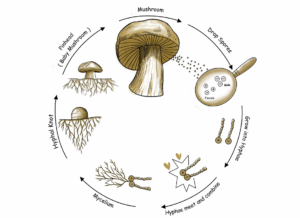
The Mushroom Lifecycle (In a Nutshell)
A mature mushroom releases spores from its cap. These spores spread into the environment and, when they land in the right conditions—moisture, nutrients, and temperature—they germinate into thin, hair-like strands called hyphae. Hyphae grow and connect to form a network called mycelium, which is basically the “body” of the fungus. A single hyphae network is primary mycelium (with half the genetic material). When two compatible primary mycelia meet, they fuse to form secondary mycelium. When the environment is right (humidity, temperature changes, and light), the mycelium forms tiny knots that develop into mushrooms—the fruiting bodies.
Why Do Mushrooms Matter to Humanity?
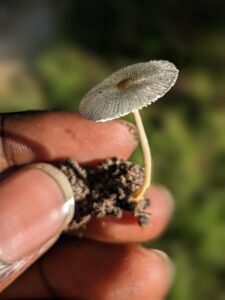
Humans have used mushrooms for thousands of years—for food, medicine, and spirituality. In Ancient China, mushrooms were key ingredients in traditional medicine. In parts of Asia and Western civilizations, mushrooms played roles in spiritual rituals, healing, and prediction. Cultivation of edible and medicinal mushrooms dates back over 4,000 years in China and Japan. which mushrooms were edible, and which were not (toxic) this probably was learned through trial and error.
Classifying Mushrooms by Human Use
Scientists estimate there are around 140,000 mushroom species, but only about 14,000 have been studied. Mushrooms can be classified in several ways, but here we focus on classification based on human use:
1. Edible Mushrooms.
These are mushrooms that can be safely consumed, their umami taste, meaty texture and unique flavors make them suitable for preparing many dishes. They contain no dangerous toxins and offer nutritious, delicious options for meals. Edible mushrooms are rich in proteins, vitamin D, K, B, fiber, while being low calories and low in cholesterol nutrients these attributes make mushrooms a healthy food option for those individuals who want to improve their health.
Edible mushrooms may be cultivated or wild—but wild mushrooms should only be eaten when properly identified.
Mushrooms are often called “plant-based meat” because they have meaty texture, rich umami flavor, and are packed with protein. interestingly, besides animal-based foods and fortified products, mushrooms are the only natural source of vitamin D. when exposed to sunlight or UV light, they produce vitamin D which supports healthy bones and skin are sometimes termed as a plant-based meat because of its similarity to meat in textures, umami taste and packed with protein. but also, apart from animal-based diets and fortified foods, mushrooms are the only source of vitamin D2, because when a mushroom is exposed to ultraviolet rays or sunrays it produces Vitamin D2 which is essential for bone and skin health.
Examples of common mushrooms,
- Button mushrooms (Agaricus bisporus)
- Oyster mushrooms (Pleurotus species)
- Shiitake (Lentinula edodes)
- Portobello (mature form of agaricus bisporus)
- Lion’s mane (Hericium erinaceus)
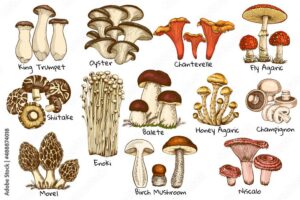
Image credit, lazymushrooms.com
2. Non-Edible Mushrooms
These mushrooms cannot be eaten reasons is that they have unpleasant tastes or contain mycotoxins which result into mushroom poisoning. There are two subgroups:
a) Medicinal Mushrooms
These mushrooms contain bioactive compounds known to support health. They have long been used in Traditional Chinese Medicine. Medicinal mushrooms are packed with bioactive compounds such as polysaccharides, terpenoids, protein and peptides, and many more, these compounds contribute to their therapeutic properties such as antioxidants, immune support, anti-inflammatory effects, cognitive benefits.
Examples of common medicinal mushrooms
- Reishi (Ganoderma lucidum)
- Turkey tail (Trametes versicolor)
- Lion’s mane (Hericium erinaceus)
- chaga (Inonotus obliquus)
- Cordyceps (Cordyceps militaris)
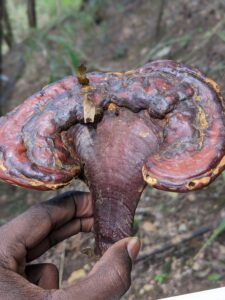
Image; Reishi (Ganoderma lucidum)
b) Poisonous Mushrooms
There are some 70 to 80 species of mushrooms that are poisonous to humans; many of them contain toxic alkaloids (muscarine, agaricine, phalline). Poisonous mushrooms when consumed, cause illness or even death deepening on the amount consumed. mushroom poisoning is the result of ingesting poisonous mushrooms; symptoms can vary from gastrointestinal discomfort to death. Correct identification is extremely important before consuming any wild mushroom.
Examples of Poisonous mushrooms
- Death cap (Amanita phalloides)
- Destroying Angels (Amanita virosa)
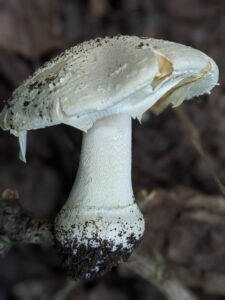
Image. Amanita spp
Final Thoughts
You now have a clearer understanding of what mushrooms are, how they appear, and their significance to humans. In upcoming posts, we’ll explore mushrooms’ roles in nutrition, health, and the environment—and how they can shape human well-being. As pioneers in mushroom innovation, Prime Mushrooms Tanzania is committed to unlocking the full potential of mushrooms for humanity.
Dear PMT, a nicely prepared and presented overview of fungi and those that produce mushrooms.
Prof. H. Wilkinson, University of Illinois
Thank you Hank.